Tuesday, January 19, 2016

Adding and Subtracting Integers

My seventh graders ALWAYS struggle with the concept of adding and subtracting integers. There are only so many "real life" ways to express positive and negative numbers, and I know I've tried them all. Sometimes they help, other times the don't, and worst of all, sometimes they seem to help when they really don't at all.

This year, I have one student that was simply not getting it, no matter what. And she was stressed out about it (typically a math minded little girl). We spent several days, drawing pictures of thermometers and talking about the temperature (helps we live in Michigan, so she was very used to temperatures dropping below zero). We drew pictures of mountains next to the sea (I even have a card game that uses this image, it's helped so many, but not her!).


I was at my wit's end when I decided to spend some alone time with my white-board and poster paper. I drew number line after number line, labeling and relabeling, organizing and reorganizing sets of facts. Until it appeared. Please tell me this is new to you, because in all of my years of teaching math and learning it through school, this pattern was NEVER pointed out to me, and I NEVER recognized it before.
In Kindergarten through third grade, we teach fact families, er, number bonds. Why don't we use that concept in seventh grade with integer equations? When my little student saw this connection, she immediately understood what going on, and flew through homework, took her test and rocked it, and is now ready to deal with positive and negative decimals. (Let's hope that goes a little more smoothly!)


The numbers in this fact family, er, number bond, are 2, 3, and 5, we must remember we are working with integers, so we also will be using the opposites of 2, 3, and 5 (-2, -3, and -5). We start with the number bond we are familiar with, 2+3=5, this is easy, we know how it works, we can apply the commutative property of addition to this equation, and just switch the place of the addends: thus 3+2=5. I wrote the out in different colors and marked them on the numberline in coordinating colors.

Now, we think about the rules we know about adding and subtracting integers. If we start with the 3, what can we add or subtract from 3 and end up at 5? My little smarty pants said, "subtracting a negative is the same as adding!" Fantastic! So 3-(-2) is virtually the same as 3+2, both result in 5 and both move on the numberline exactly the same. So we wrote that in another color and marked it on the numberline. You can see the blue and red following the same movement.

The next step was to apply the commutative property (in a sense) to this expression and see if it resulted in the same movements as out other number. That would be 2 -(-3), and sure enough, it does, It followed the same exact pattern as 2-3! ALL of these expressions are equal 5, AND work like addition on the numberline (moving spaces to the right of the starting number).

Next we moved on to adding negatives. My little student understood the concept of adding negatives and gaining negative distance from 0. She knew that to find the sum you add the absolute value and take its opposite. Easy as cake! Now what if you apply the commutative property of addition? YES! She found that -3+-2=-5 and -2+-3=-5.

Just like we did before, we stopped and asked ourselves, Is there any other way to start at -3 and end up at -5? YES! She immediately said, if you KCC! Gah! I can take a moment to express my loathing of this term? So she meant to keep the state of the first term, change the operation and the state of the second term. So, -3+-2 becomes -3-2. And yes, unfortunately, it works! I explained that is because adding a negative works the same as subtracting a positive, looks at our matching movements on the numberline ;)

Finally, we apply the commutative property (sort of) to -3-2 and we see that -2-3 ends at -5! My smarty pants students says, "Bah, BAM!"

Let me just take a moment and clarify that "sort of" application of the commutative property. We are really just expressing the same concept with different operations. We know that 3+2=5 and 2+3=5, that IS the result of applying the commutative property. However, when we are dealing with negative numbers, it doesn't always look so pretty. -2-3 is subtraction, and the property is only applicable to addition (and multiplication). However, when subtracting on the left side of zero, the numbers work together during subtraction as they normally do during addition on the right side.


We are to the related fact family, er, number bond, are 2, 3, and 1, we must remember we are working with integers, so we also will be using the opposites of 2, 3, and 1 (-2, -3, and -1). This time we'll be focusing on subtraction. We started with the more difficult to visualize bond, so let's just pretend we started with the bond we are more familiar with, 3-2=1. We remember from our last exercise that subtraction is the same as adding a negative, so 3+(-2) should work the same as 3-2. Notice our color-coded movements on the numberline (green & blue on the top). Sure enough, it works!

Now let's apply the commutative property of addition to the last expression, 3+(-2) should equal (-2)+3, and it does! And our related expression, using our knowledge that subtracting a negative is the same as adding a positive (KCC, or Chum Chum). -2-(-3) is in fact 1!

But, what about that expression my dear student and I started with? 2-3. For those of us who have been working with these numbers for years, it's easy to see the result is -1, but what about our students who have been told for years you can't subtract a number from a value that is smaller? The number line really helps in this situation, As the student hops back 3 spaces from 2, they can clearly see the difference is -1. We also know that subtraction is the same as adding a negative, so we can re-write that equation to 2+(-3).

Applying the commutative property to that expression results in -3+2. We can reason without the number line that if I lost 3 pencils, and then found 2, I'm still missing 1, so yes, this expression equals -1. And then to find it's related expression, we must think, how else can get back to -1 when starting at -3? This is our KCC or chum chum "trick" (gah, I hate tricks!). -3+2 is the same as -3-(-2).

The actually math logic behind this trick is really much simpler than the trick itself. It's all about following the road signs. On our chart we wrote the negative (subtraction) sign with the arrow pointing left and the positive (addition) sign with the arrow pointing right. That is essentially the way the operation force numbers to move on the number line, regardless of the numbers value or sign. When the number that follows the operation is negative, it tells you to turn around (do a U-turn) and move the opposite direction. My son calls this illegal U-turns ;)

I hope some of these math meanderings will help you to help your students make sense of adding and subtracting integers. A while back I created a fun packet to help my 7th graders rewrite expressions into something easier to work with. In the end they create a colored page of a character most of them love.


Friday, January 8, 2016

Pre-Pre-Algebra...Is there such a thing?

No, that is not a typo, I meant to say pre-pre-algebra. They don't call it that, but what else do you call whatever is going on in 6th grades across America these days? My two youngest were in 6th grade last year, and their text book was called "Algebra and Geometry Fundamentals." Most of their "Core Focus" questions came straight from a high school Algebra textbook, yet they were told to solve using picture models, guess-and-test method, and things called number tiles. They haven't been properly educated on the Algebra rules and algorithms, so my hands were tied in using them.

Here is an example that was recently brought to my attention by another tutor. Her 6th grade student was given this question:

How do you go about teaching this young student to solve this problem without using a system of equations? 

First, we have to figure out what the information is telling us. I like to use tables, it leads nicely into functions later on, and organizes all of the information so nicely!

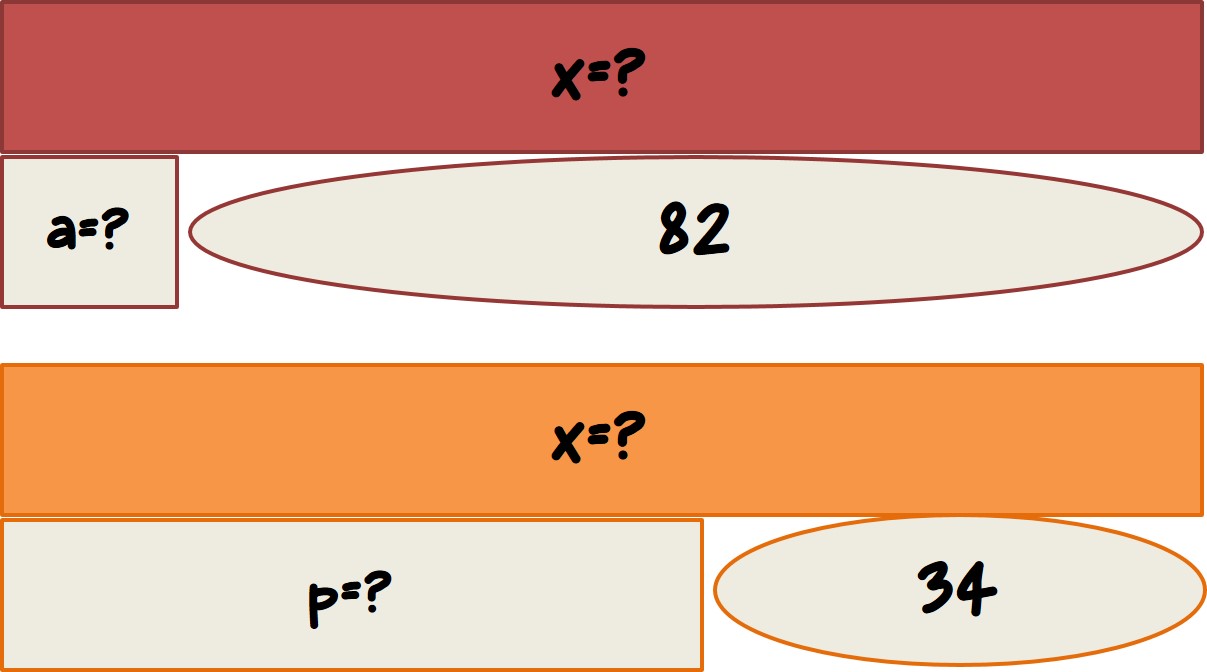
I can see right away that I could use comparison bars to represent two different subtraction equations. I see the amount of apples I started with, minus the amount I sold, equals the amount I have now; or x-82=a And I see the amount of pears I started with, minus the amount I sold, equals the amount I have now; or x-34=p. 

But these equations are missing too much information to solve. So I need to try to figure out some of the other missing details. I used "x" for the start of both equations because the story told me that there were the same number of apples and pears to begin with. I can use that to look at the comparison given. The story said that I now have 4 times as many pears as apples. That means, for every 1 apple, I have 4 pears. 

If I were doing a legit algebra problem I could use that information and replace the "p" in my second equation with 4x. BUT, we are only 6th graders and don't understand how to use a system of equations. So we have to think like scientists for a minute. 

There are 3 facts about this problem that will help us solve it. 
  1. BOTH fruits started with an equal quantity. 
  2. Different amounts have been sold.
  3. The ratio of the remaining fruits is 1:4
For my low students, I would suggest the guess-and-test method to solve this. I despise that term and if there is ANYway possible you can avoid using and burning it into your young students minds, I really think that would be great. But it is a method that is taught. I'll just simply ask my students, "what numbers do you think will make this work?" It's kind of like looking at a broken bicycle and asking a child what will make that bike go again? Most students will likely pull a random number from thin air, with no rhyme or reason. Take it and work with it. I find that if you focus in on how to hypothesize at this point, you lose the math point.

 
To help my more advanced students get this process started, I might focus in on the ratio of the remaining parts, and the difference in the amounts sold. These numbers give clues so the "guess" part of the problem solving can have a little more rhythm. It also can save A LOT of time on tests! Looking at the number tiles below, you can see an overlap. The difference in the remaining amounts is 3 parts (not to be confused with 3 pieces of fruit!), The difference between the amounts sold is 82-34=48. If we divide those 48 pieces of fruit into 3 parts, each one will be 16 pieces of fruit. We can use that 16 to solve now, without using that table and 5 or six "guesses" that may or may not end up leading us to the right answer. 


If this has got you all feeling, "why do we even have to teach this way?" Trust me, I understand! Here's what I have been telling myself:
  1. These kids still need practice with their basic facts, none have them memorized, and NONE want to memorize them because they don't see the need. This tricks them into  using those skills for a purpose! They get real life (sort of) practice using the basic facts and rules of math to solve problems.
  2. They are also getting practice working with numbers in a complex situation they might never encounter naturally before Algebra begins for real. This should ease their fears and provide some background knowledge for those teachers to capitalize on later.
  3. Finally, they are problem solving, no matter what method is used, or how complex the steps are to get to the answer. Math is about finding a solution to a problem, based on what can be observed and what can be determined. This is a skill that transfers to every area of life. 
Until next time!

Wednesday, January 6, 2016

Have you heard of WEO?

I'm always looking for ways to encourage my students to keep working on their skills between our lessons. I don't believe in the old memorization routines, however, I am a firm believer in practice makes improvement! Trying to find a way to keep connected with my students outside of class, and yet accountable was a challenge! A few months ago I stumbled onto a fairly new site (through my Facebook feed) called WEO.

It looks and feels a little bit like Pinterest, in fact the company boasts that it is a Pinterest for teachers. I kind of laughed at that because we already all use Pinterest don't we? After a little digging I figured out what they meant. It isn't an idea/product pinning system, it's a lesson/assessment pinning system. Pretty cool right?

When I create a lesson for my students, the system automatically tracks their progress, tells me when they've worked on it, and even auto grades their responses if I set up the answers for it. It's saving me a ton of paper! Instead of giving worksheets or handouts for my students to practice over breaks and weekends, I now tell them to log onto WEO and see what's new!

It's free and easy to set up an account, I just signed up using my Google id. It's also super easy for students to sign up and join a class. I have 2 running right now, a GED prep and an Algebra basics. As a teacher I am given a code for each class that I can give to my students, and then they enter the code to join the class (a bit like Edmodo works).

I recently had the opportunity to ask Josh, one of the administrators of the site, a few questions I thought other teachers/tutors might have about using the site.

1. Can students access the assignments on any internet device? If not, what are the specific restrictions?
Students can use Weo on any device with an updated browser, although it works best with chrome and we wouldn't recommend using it on a phone. 
2. Is WEO a viable source for online tutoring partnerships? Meaning, can I assign lessons to an online student I work with in a different country?

Weo is definitely a viable tool for tutoring remotely. In fact, we have companies that use Weo for remote training. As long as your students have an internet connected computer and an updated browser they are good to go.

3. If I find a great assignment from another teacher and want to assign it to my class, will it still auto grade or will I have to edit it? Can I edit it?

All assignments in our system will auto grade regardless of whether it's yours or someone else's. If you want to make changes to someone else's assignment, you can pin it to one of your boards and then edit it. The edit option can be found in the top right corner once you've opened up the pinned activity.

4. Can I use the site as both a teacher and student? I am a math teacher, but might one day take French lessons, can I join a class as a student with my teacher account?
We will definitely be adding the ability to be both a teacher and a student sometime soon. However, right now you'd have to create a separate student account  to join someone's class.
Thank you for that brief interview Josh! 
Here's a link to my profile if you want to check it out. 
Oh, one more thing I want to share with you about this new platform, they are paying teachers for creating lessons right now. I was a bit leary of this at first, since I already have a store on Teachers Pay Teachers. But it's nice to get a little paypal bonus for something that is benefitting my students anyway! Here's the page that describes the curriculum development program. They explain how to get started, how to qualify for payments, and the pay scale for lessons. 
After you check it out, come back here and let me know what you think!

Tuesday, December 22, 2015

Multiplication Strategies Part 1

I've had several parents ask for some assistance helping their kids learn multiplication and division. They don't want another video, worksheet, or app. They just want someone to sit down with them and help them develop strategies for helping their children learn their facts. Are you among them? I'm compiling a list of helps here. I'll add to it as time goes on.

The first thing I always tell parents is that I believe some people aren't really capable of memorizing facts. I know this sounds like I'm saying they can't learn, it's is not the same thing I promise. But rote memorization really truly does not work for some people and has been the cause of frustration in the mathematics classroom for years. I have a firm belief that some math students will need to develop strategies and habits, which will help them retrieve information stored in their brain. This might include using fingers, counting objects in the room, or visualizing dots in their minds. Guess what? Their math teachers and tutors at times count on their fingers, look at concrete objects, and/or visualize patterns to solve problems as well!

1. Use the distributive Property.

The distributive property is one of the basic laws of how numbers work with each other. It works with both addition and multiplication, and helps students break down larger facts into more bite-sized facts that are easier to solve. The reason this strategy works well is it is not a trick, it's a law of numbers. It helps math students break apart numbers and use their values to find related facts they've already memorized or effectively stored for retrieval. The distributive property of multiplication basically states that numbers can be spread out to be multiplied and added to make an operation easier to solve.

Here is an example. Let's multiply 3 x 6. I'm starting off with a seemingly simple fact so it's easy to see how this works.


My student says, "Miss Stefany, I don't know my sixes!"
"Ok, what about your threes?"
My student, "No, I don't know my threes either!"
"No problem, do you remember how to count by 2s?"
My student, "Yes, 2, 4, 6, 8..."
"Perfect!"

Now you're asking, "How on earth is counting by 2s going to help me multiply 3 and 6?"
For that answer we need to go back to our basic addition facts. 6 is equal 2 + 4, correct? The distributive property of multiplication tells us that if 2+4=6 then 3x6=(3x2)+(3x4).


If you count the blocks in the diagram, you'll see that it works. There are 18 blocks in the 3 by 6 grid and there are 18 blocks in the 3 by 2 and 3 by 4 grid as well!

Maybe your student doesn't know his fours yet either. No problem, just break it down a further step. If 6=2+4 it also equals 2+2+2. So 3x6 also equals (3x2)+(3+2)+(3x2).


Again, counting the blocks shows that it works! And I can assure you, it works every time, no matter what the numbers are or how big they are.

You can also break the numbers down into any of their equal parts.
For example, 6=1+5, so 3x6=(3x1)+(3x5)
                      6=3+3, so 3x6=(3x3)+(3x3)

Just a tidbit here. If you your child was among those learning all the partners of numbers over the past 3 years with their Common Core Curriculum, and you couldn't figure out what they would ever do with that. Here it is! Be thankful they spent so much time with that concept, because now this will make so much more sense. If your child wasn't one of the students drilled on this skill, then see this post here for more information that might make using this strategy a little more clear.

Would you like to try some multiplication problems using this strategy with answer guide to check your work? Here's a freebie just for parents!


Most Popular Posts Lately